


Crane sheaves are grooved wheels that guide and redirect wire ropes, support reeving arrangements, and transmit lifting forces through a crane’s hoisting system. Common types include boom tip sheaves, hook block sheaves, fixed sheaves, movable sheaves, equaliser sheaves, and guide or deflection sheaves. The correct type of sheave depends on the crane’s configuration, the rope’s construction, the load conditions and the operating environment. Important engineering and safety guidance on sheave geometry, wire-rope compatibility, guarding, lubrication, and inspection can be found in the CMAA Specification No. 70 and ASME B30.2.
What Are Crane Sheaves and How Do They Work?
A crane sheave is a rotating wheel with a groove around its circumference designed to accommodate a wire rope. It is usually mounted on a shaft or pin and supported by bearings or bushings. As the rope moves over the sheave, the direction of the rope changes, or the sheave forms part of a reeving system that distributes the load across multiple rope sections. Sheaves are found in various types of cranes, including overhead, gantry, tower, mobile, and port cranes, as well as in marine deck equipment and other lifting machinery.
While the basic operating principle is straightforward, the engineering function is important. A sheave redirects the rope while allowing it to move with reduced sliding friction. In a multi-part reeving arrangement, several sheaves work together to create multiple supporting rope parts between the hoist and the hook block. This arrangement provides a mechanical advantage, enabling the hoisting system to lift a heavier load with a corresponding change in rope travel and line speed. The actual load distribution depends on the geometry of the reeving, friction, the condition of the rope, and the crane’s mechanical design.
A crane sheave cannot be selected based on outside diameter alone. Its pitch diameter, groove profile, material, bearing arrangement, shaft dimensions, and load capacity must all be matched to the wire rope and crane design. Incorrect geometry can accelerate rope fatigue, cause abnormal wear, increase friction, and create rope-tracking problems. For this reason, sheave selection and replacement should follow the crane manufacturer’s specifications and applicable engineering standards rather than a generic size chart.

What Are the Different Types of Crane Sheaves?
Crane sheaves can be classified by their position in the crane, their function in the rope path, and whether they move with the load or remain fixed to the structure. The following categories describe common arrangements used in lifting systems. A single crane may use several types simultaneously.
- Boom Tip Sheaves
Boom tip sheaves are installed at the end of a crane boom. Their primary function is to guide the hoist rope from the boom structure towards the hook or load. Depending on the reeving arrangement and rated lifting configuration, mobile and crawler cranes may have one or more sheaves in the boom head.
These sheaves operate under substantial rope tension and undergo repeated bending cycles as the crane lifts and lowers loads. The groove profile of the sheaves must match that of the specified wire rope, while their diameter must satisfy the bending requirements of the crane design. Boom tip sheaves also require suitable guards and alignment to minimise the risk of rope derailment, especially when changing boom angles or when the rope becomes temporarily slack.
- Hook Block Sheaves
Hook block sheaves are mounted inside the lower block assembly, which is connected to the lifting hook. The wire rope passes through the grooves of these sheaves as part of the crane’s reeving system. By using multiple rope parts, the hook block arrangement helps distribute the lifted load across several sections of rope and changes the relationship between hoisting force and lifting speed.
The number and arrangement of hook block sheaves depend on the crane’s capacity, hoist configuration, rope diameter, and required lifting height. More sheaves do not automatically mean a better lifting system: each additional rope bend introduces friction and another bending cycle. The block must therefore be designed as a coordinated assembly, including side plates, pins, bearings, guards, and hook connections.
- Fixed Sheaves
Fixed sheaves are mounted in a fixed position on the crane structure. They redirect the wire rope without moving vertically with the load. Depending on the machine, fixed sheaves may be installed on the boom head, the overhead trolley, the hoist frame, or other structural locations where the rope needs to change direction.
Their primary function is to establish and maintain the intended reeving geometry of the rope path. Although a fixed sheave does not travel with the hook, it still experiences radial loading, bearing reactions, and repeated rope bending. The support structure and mounting arrangement must therefore be designed to withstand these forces without excessive deflection or misalignment.
- Movable Sheaves
Movable sheaves travel as part of a moving block or lifting assembly. In common crane reeving systems, they are incorporated into the hook block so that multiple rope parts support the lifted load. This arrangement can provide mechanical advantage, reducing the line pull required from the hoist for a given load, although the rope must travel farther to achieve the same lifting distance.
Movable sheaves are therefore central to the lifting capacity and operating characteristics of many cranes. Their performance depends on correct reeving, bearing condition, groove compatibility, and the integrity of the block assembly. Any modification to the number or arrangement of movable sheaves can affect the crane’s rated capacity and must be reviewed by the responsible crane designer or qualified engineering personnel.
- Equalizer Sheaves
Equaliser sheaves are used in selected multi-rope or multi-part hoisting arrangements to accommodate differences in rope movement and maintain intended load-sharing behaviour. They can be incorporated into overhead crane systems and other specialised lifting configurations where the geometry requires compensation between rope sections.
An equalizer sheave should not be treated as interchangeable with an ordinary running sheave. Its function and loading conditions depend on the specific reeving design. CMAA Specification No. 70 provides separate guidance for equaliser sheave pitch diameters, demonstrating that their sizing considerations may differ from those of running sheaves.
- Guide and Deflection Sheaves
Guide or deflection sheaves are installed wherever a wire rope needs to change direction between the hoist drum, boom, trolley, or other parts of the crane. They help maintain the intended rope route and prevent interference with structural members or adjacent equipment.
Although these sheaves may not be directly attached to the hook block, they remain important to overall hoisting performance. Poor alignment or excessive fleet angle can cause the rope to climb the groove flank, rub against guards, or develop abnormal wear. Their position should therefore be checked as part of the complete reeving layout, not assessed in isolation.
Crane Sheave Materials and Construction
The material used to manufacture a crane sheave affects its strength, resistance to wear, machinability, behaviour in relation to corrosion, and service life. The material selected should reflect the crane’s rated loads, operating frequency, rope characteristics, and working environment. For example, a material that performs well in an indoor factory crane may not be suitable for a marine or offshore crane that is exposed to saltwater, moisture, and changing weather conditions.
Common material options include:
- Cast steel: Used in many industrial and heavy-duty lifting applications. It offers good strength and design flexibility, although casting quality, heat treatment, and inspection are important to ensure structural integrity.
- Forged steel: Often considered for demanding applications where strength, toughness, and material integrity are important. Forging and subsequent machining must be controlled to achieve the required dimensions and mechanical properties.
- Ductile iron: Offers a balance of strength, castability, vibration damping, and manufacturing cost. Its suitability depends on the design loads and the manufacturer’s specified material grade.
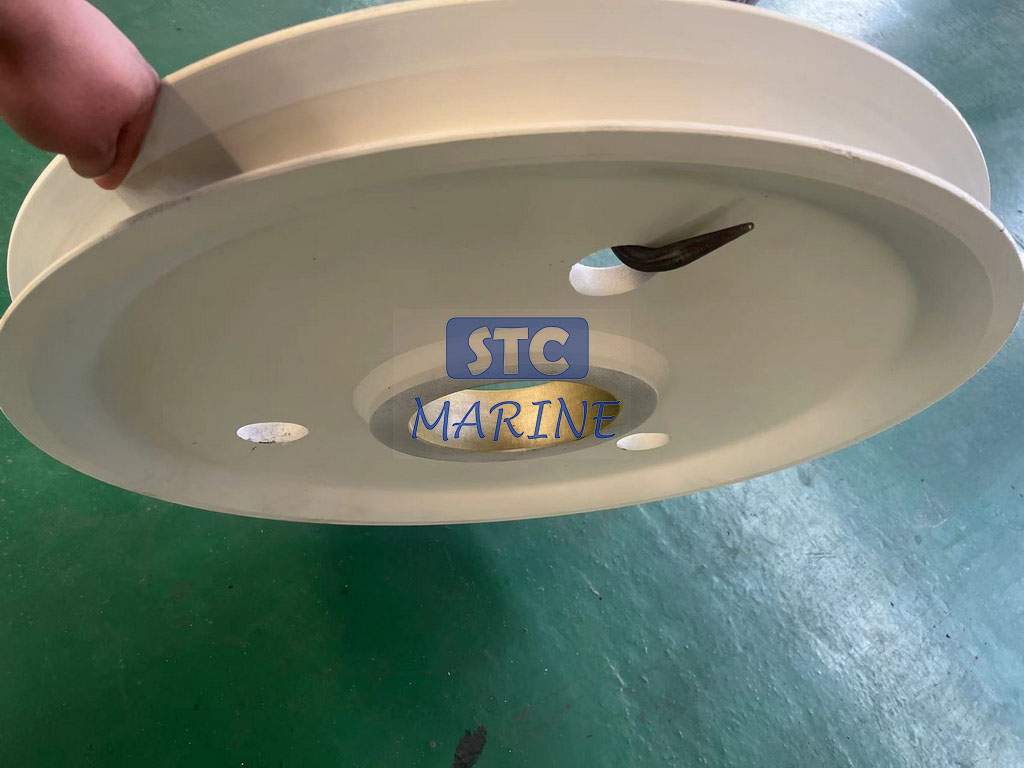
- Polymer or lined sheaves: Used in selected specialized applications to reduce noise, contact wear, or corrosion-related problems. Their use must be supported by engineering assessment of load capacity, temperature, rope compatibility, and environmental conditions.
Particular attention should be given to corrosion protection and bearing sealing for marine and offshore equipment. Although protective coatings, suitable material grades, sealed bearings, and appropriate lubrication can help reduce deterioration, no coating or material choice eliminates the need for regular inspection. The entire sheave assembly, including the wheel, hub, bearing, pin, and retaining components, must be suitable for the intended service conditions.
Critical Design Factors When Selecting Crane Sheaves
Selecting a crane sheave involves more than just matching the outside diameter or bore. It must be compatible with the wire rope and the crane’s reeving arrangement, and it must also meet the mechanical and environmental demands of the application. The following design factors should be considered in conjunction with each other.
- Sheave Diameter and D/d Ratio
The D/d ratio is the relationship between the sheave pitch diameter (D) and the nominal wire rope diameter (d):
D/d = Sheave pitch diameter/Wire rope diameter
For example, if a wire rope has a nominal diameter of 20 mm and the sheave pitch diameter is 400 mm, the D/d ratio would be 20:1. The pitch diameter is measured at the centreline of the rope when it is seated in the groove, rather than at the outer edge of the sheave.
A larger D/d ratio generally reduces the severity of rope bending and can improve fatigue life. However, the required ratio depends on rope construction, crane classification, operating conditions, and applicable design standards. CMAA Specification No. 70 provides recommended minimum drum and running-sheave ratios for specific rope constructions and crane service classes. It should not be interpreted as a single universal ratio applicable to all cranes.
- Groove Profile and Rope Compatibility
The groove is the contact surface between the sheave and the wire rope. Its radius must provide appropriate support without pinching the rope or allowing it to sit too loosely. A groove that is too narrow can compress the rope and increase contact pressure, while an excessively wide or worn groove may fail to support the rope correctly.
Groove radius, depth, angle, surface finish, and wear condition should be checked against the rope manufacturer’s recommendations and the crane manufacturer’s requirements. Usha Martin’s wire-rope guidance emphasizes checking groove dimensions with a suitable sheave gauge and inspecting the interface components before installing a replacement rope.
- Bearing and Shaft Design
Bearings enable the sheave to rotate as the rope moves through the lifting system. Depending on factors such as load, speed, environment, and maintenance strategy, a crane sheave may use rolling-element bearings, bushings, or other specified arrangements. When selecting bearings, it is important to consider radial loads, rotational speed, lubrication, contamination and expected operating cycles.
The shaft or pin must also be able to withstand the forces transferred through the sheave assembly. Incorrect bearing clearances, poor retention, inadequate lubrication, or misaligned shafts can lead to increased friction, abnormal noise, overheating, and accelerated wear. For critical lifting equipment, the entire assembly should be evaluated rather than selecting a wheel in isolation from its bearing and mounting system.
- Fleet Angle and Rope Alignment
Fleet angle describes the angle at which a wire rope approaches or leaves a sheave relative to the intended rope path. Excessive fleet angle can cause the rope to ride against the groove flank, introduce additional twisting, and increase side wear. Alignment is especially important in systems where the rope moves across a wide drum or passes through multiple sheaves.
CMAA Specification No. 70 recommends limiting the rope fleet angle for sheaves to a slope of 1 in 12, approximately 4°45′, within the scope of that specification. This value should not be applied indiscriminately to every crane or rope construction; the applicable crane design and wire-rope manufacturer’s guidance take precedence.
| Design factor | What needs to be checked | Potential consequence of poor selection |
| Pitch diameter and D/d ratio | Compatibility with rope diameter, construction, and crane duty | Increased bending fatigue and reduced rope life |
| Groove profile | Groove radius, depth, angle, finish, and wear | Rope pinching, flattening, abrasion, or unstable seating |
| Material | Strength, toughness, wear resistance, and corrosion behavior | Deformation, cracking, or premature surface deterioration |
| Bearings and shaft | Load rating, fit, lubrication, retention, and alignment | Increased friction, overheating, or bearing failure |
| Fleet angle | Rope approach direction and sheave alignment | Sidewall wear, twisting, and rope tracking problems |
| Guards and flanges | Rope retention and protection against derailment | Rope jump-out or contact with surrounding components |
How to Choose Crane Sheaves for Different Applications?
Different crane types operate under different load spectra, duty cycles, and environmental conditions. The most suitable sheave should therefore be selected according to the actual lifting application rather than a generic preference for a particular material or construction.
| Crane application | Typical sheave priorities | Key considerations |
| Overhead and gantry cranes | Accurate grooves, reliable bearings, stable rope tracking | Repetitive lifting cycles and alignment within the hoist system |
| Mobile cranes | High-strength construction, suitable D/d ratio, robust bearings | Variable loads, boom movement, and frequent rope bending |
| Tower cranes | Correct rope guidance, groove durability, suitable reeving geometry | Long lifting paths, operating height, and changing load conditions |
| Port and shipyard cranes | Wear resistance, corrosion protection, maintainability | High operating frequency, outdoor exposure, and abrasive environments |
| Marine and offshore cranes | Corrosion-resistant protection, sealed bearings, application-specific construction | Saltwater, humidity, dynamic loading, and demanding service conditions |
| Auxiliary hoists and luffing systems | Correct dimensions and smooth rope guidance | Different rope speeds, reeving arrangements, and directional changes |
When buying marine lifting equipment, it is important to pay particular attention to corrosion protection, bearing sealing, material traceability, and the availability of application-specific replacement components. When assessing marine crane component requirements, we consider suppliers with relevant experience with the equipment, such as STC Marine Engineering Limited, which lists crane sheaves among its marine equipment products, alongside hydraulic components and related services.
Before placing an order, provide the supplier with the crane model, equipment drawings, wire rope specification, dimensions of the existing sheaves, and operating conditions. If the replacement is intended to match an existing assembly, confirm the pitch diameter, groove geometry, bore, hub dimensions, bearing arrangement, and mounting details. A visually similar sheave is not necessarily interchangeable.
Crane Sheave Inspection and Maintenance
Crane sheaves and wire ropes should be inspected together as they are related components; damage to one can accelerate the deterioration of the other. A sheave may still rotate even if its groove is worn or distorted enough to damage a new rope. Similarly, abnormal wear to the rope may indicate an issue with the alignment of the sheave, the condition of the bearing, or the geometry of the groove, rather than a defect in the rope itself.
A practical inspection program should include the following checks:
- Groove condition: Look for uneven wear, scoring, sharp edges, deformation, cracking, and incorrect rope seating. Use an appropriate gauge to assess groove dimensions against the specified limits.
- Flanges and guards: Inspect for cracks, deformation, damaged edges, loose fasteners, and missing rope-retention components.
- Bearings and rotation: Check for smooth rotation, abnormal noise, excessive play, overheating, and lubrication problems. Confirm that lubrication arrangements are maintained as specified.
- Rope tracking and alignment: Observe how the rope enters and leaves the groove. Look for side rubbing, twisting, climbing, or signs of derailment.
- Corrosion and surface damage: Pay particular attention to marine and outdoor installations, where moisture and salt can damage exposed surfaces and bearing components.
- Maintenance records: Record inspection findings, repairs, groove measurements, and replacement decisions so that developing wear patterns can be identified over time.
ASME B30.2 addresses sheave groove condition, rope guidance, guards, and lubrication for the overhead and gantry crane equipment within its scope. It also requires inspection practices appropriate to the crane’s service conditions. The applicable edition, crane category, manufacturer’s instructions, and local regulations should be consulted when establishing inspection intervals and discard criteria.
A sheave should not be repaired or returned to service solely because it appears intact. Re-machining may be possible in some cases, but only when the remaining material thickness, groove geometry, and manufacturer-approved repair limits allow it. Cracked, significantly deformed, or otherwise unsafe components should be assessed by a qualified person and replaced when required.
Frequently Asked Questions About Crane Sheaves
- What is the function of a sheave on a crane?
A crane sheave guides and redirects the wire rope while supporting the reeving arrangement used to lift loads. Multiple sheaves can also create mechanical advantage by distributing the load across several rope parts.
- What are the main types of crane sheaves?
Common types include boom tip sheaves, hook block sheaves, fixed sheaves, movable sheaves, equalizer sheaves, and guide or deflection sheaves. Their functions depend on their position and role in the crane’s rope path.
- What is the D/d ratio of a crane sheave?
The D/d ratio is the sheave pitch diameter divided by the nominal wire rope diameter. It is an important design factor because it affects rope bending severity and fatigue life.
- What materials are used to manufacture crane sheaves?
Common materials include cast steel, forged steel, and ductile iron, while specialized applications may use polymer or lined designs. The choice depends on load requirements, wear resistance, environmental exposure, and compatibility with the wire rope.
- How do I know when a crane sheave needs replacement?
Warning signs include cracked or distorted flanges, worn or incorrectly shaped grooves, rough rotation, bearing noise, corrosion, and abnormal wire-rope wear. The final replacement decision should follow the crane manufacturer’s limits and assessment by a qualified person.
- Can a worn crane sheave damage a new wire rope?
Yes. An incorrectly sized, rough, or worn groove can pinch, abrade, or misguide a new wire rope, causing premature deterioration even when the rope itself meets its specification.
Conclusion
Crane sheaves are essential components of wire-rope hoisting systems. They guide the movement of ropes, change the direction of lifting, and support the reeving arrangements that enable cranes to handle different load capacities. The various types of sheaves, such as boom tip, hook block, fixed, movable, equaliser, and guide, each serve a specific function within the overall crane design. Their performance depends on correct geometry, suitable materials, reliable bearings, and accurate rope alignment.
When selecting or replacing crane sheaves, engineers and equipment buyers should consider the wire rope construction, D/d ratio, groove profile, bearing arrangement, crane duty cycle and operating environment as part of the whole system. Regular inspection of both the sheaves and wire ropes is equally important for identifying wear before it develops into a more serious operational problem. Correctly specifying and maintaining sheaves helps to protect the life of the rope, maintain lifting reliability, and support safe crane operation.