


In a crane, sheaves are grooved wheels that guide, support, and redirect the wire rope, helping the crane to lift loads efficiently via reeving systems. Properly designed crane sheaves not only change the direction of the rope but also reduce rope bending stress, distribute the load across multiple parts of the line, and improve the mechanical advantage in hook blocks and boom-tip assemblies. According to the ASME B30 standard, the Wire Rope User’s Handbook and rigging guidance used in crane and hoisting practice, the diameter of the sheave, the profile of the groove, and the alignment directly affect rope fatigue, the smoothness with which loads are handled, and the service life of the entire lifting system.
In short, a crane sheave is one of the most critical ‘hidden’ components in a lifting system. If a sheave is undersized, worn, misaligned, or poorly matched to the wire rope, it can accelerate rope wear, increase operating friction, and reduce lifting efficiency. It can also compromise safety long before obvious signs of failure appear in the hook, drum, or hoist.
Introduction
When people think about cranes, they tend to focus on the large, visible components such as the boom, hook block, hoist drum, trolley, and steel structure. However, some of the most important parts of a crane are much smaller and less visible. Crane sheaves, for example, play a decisive role in how safely and efficiently a crane lifts, lowers, and controls a load.
Although a sheave may appear simple — a grooved wheel mounted on a shaft — in crane engineering, it performs several essential mechanical tasks simultaneously. It guides the wire rope along the intended path, changes the direction of the pulling force, supports the reeving arrangement that multiplies the lifting capacity, and helps to maintain proper rope contact and bending geometry. Without sheaves, most crane hoisting systems would be unable to achieve the necessary hook travel, line pull, or load distribution for modern lifting operations.
This is why the function of sheaves in a crane should not be understood as merely a “pulley” function. In practice, sheaves influence rope life, hook block configuration, load stability, maintenance intervals, hoisting efficiency, and the crane’s overall reliability. Understanding how crane sheaves work is therefore fundamental for manufacturers, operators, maintenance engineers, and buyers to make better design, selection, and maintenance decisions.
What Is a Crane Sheave?
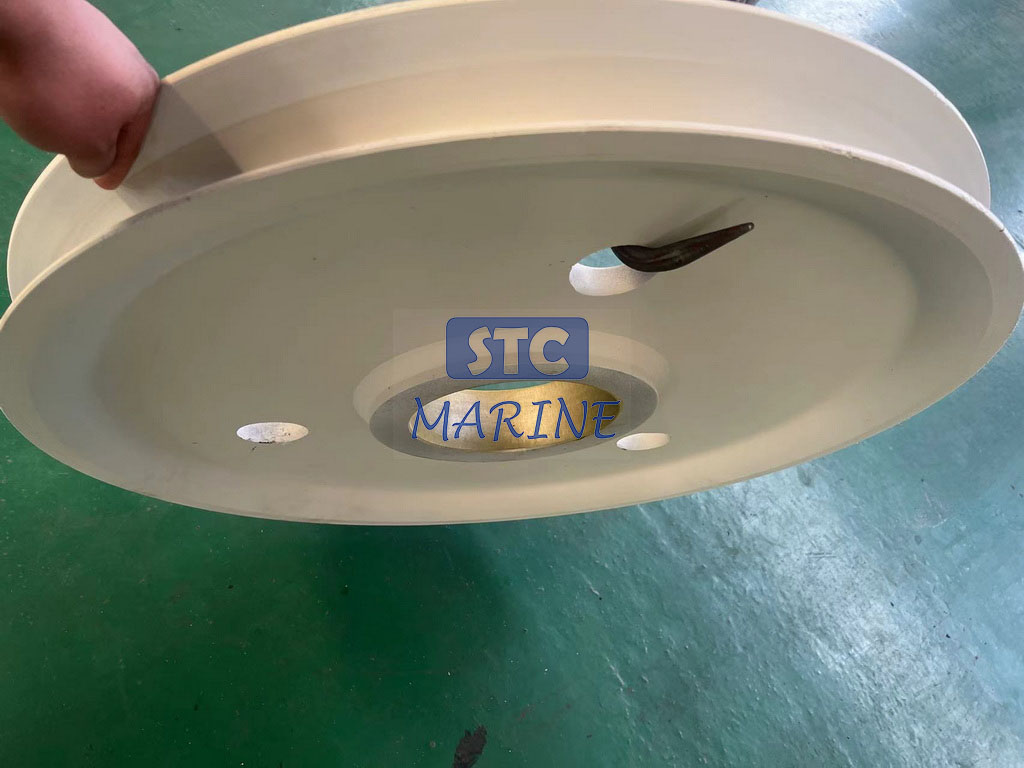
A crane sheave is a grooved wheel that carries and guides wire rope within a crane’s hoisting or luffing system. It is mounted so that the rope runs inside a machined groove on the outer rim of the wheel. As the rope moves, the sheave rotates, enabling the rope to change direction with less sliding friction than if it were dragged over a fixed surface.
Sheaves are commonly installed in the following locations in lifting equipment:
- The boom tip
- The hook block
- The headache ball or overhaul ball assembly
- The equaliser assembly
- The gantry or trolley hoist system
- Auxiliary reeving points in marine and offshore lifting equipment
Although the sheave itself is mechanically simple, its design must be carefully matched to the rope and the crane’s duty cycle. The groove shape, groove depth, pitch diameter, flange height, bearing arrangement, and material all influence how the rope seats in the groove and how stress is transferred during lifting.
Therefore, a crane sheave acts as both a motion-guiding component and a load-bearing rope support element. It is not merely a wheel that ‘turns’; it is a controlled contact interface between the crane and the wire rope system.
What Is the Function of Sheaves in a Crane?
The direct answer is that crane sheaves guide and support the wire rope while enabling the crane to lift loads through the redirection of force and mechanical advantage. But in real-world crane operation, that function breaks down into several distinct engineering roles.
-
Redirecting the Wire Rope Path
The most obvious function of a sheave is to redirect the path of the wire rope. In many crane systems, the hoist drum is not aligned directly above the hook. The rope must travel from the drum, around one or more boom-tip sheaves, through the hook block, and back through the reeving system before reaching its dead end or anchorage point.
Without sheaves, the rope could not follow this controlled path. The sheave allows the rope to turn around a defined radius while continuing to move under tension. This redirection is essential in tower cranes, overhead cranes, mobile cranes, marine cranes, pedestal cranes, and other rope-operated lifting systems.
-
Creating Mechanical Advantage
A second major function of sheaves is to create mechanical advantage through reeving. When the rope passes through multiple sheaves in a hook block and boom head arrangement, the crane can divide the load across several parts of the line. This reduces the line pull required from the hoist and increases the crane’s effective lifting capacity within the reeving configuration.
For example, a single-part line may be suitable for lighter loads and faster hook travel, while a multi-part reeving system uses multiple crane sheaves to increase lifting capability for heavier loads. In this sense, the sheave is a core component in the block-and-tackle principle applied to modern cranes.
-
Supporting the Rope During Bending
Every time a wire rope changes direction over a sheave, it bends. Repeated bending is one of the primary causes of rope fatigue. A properly sized sheave supports the rope over a groove profile designed to minimize damaging stress concentration and flattening of the rope strands.
This is one of the most overlooked functions of crane sheaves. They do not just “carry” the rope; they protect it by controlling how it bends. Industry guidance consistently emphasizes that sheave diameter relative to rope diameter—often discussed as the D/d ratio—has a major effect on rope life. Larger, correctly matched sheaves generally reduce bending fatigue and extend service life.
-
Distributing Load Through the Reeving System
In a properly reeved crane, sheaves help distribute the load across multiple rope segments. This reduces localized overload on a single rope section and allows the crane to lift heavy loads more safely and efficiently. Hook blocks with multiple sheaves are designed specifically to manage this load-sharing effect.
Load distribution also affects rope stretch, hook block stability, and the forces transmitted into the boom head and drum. In other words, the sheave is part of the crane’s structural force path, not just an accessory attached to it.
-
Improving Hoisting Smoothness and Efficiency
Because a rotating sheave offers rolling support rather than sliding contact, it reduces friction during rope travel. Lower friction helps improve hoisting smoothness, reduces heat buildup, and minimizes wear at rope contact points.
If a sheave bearing seizes or the groove becomes badly worn, the rope may stop rolling cleanly and begin dragging. This increases friction dramatically and can accelerate rope damage. So one practical function of the sheave is to maintain smooth, controlled rope movement throughout the lifting cycle.
How Crane Sheaves Work with Wire Rope and Hook Blocks?
To understand the function of crane sheaves, it helps to look at the rope path inside a typical crane.
In a simple single-line hoist, the rope may leave the drum, pass over a boom-tip sheave, and connect to the hook or load-handling attachment. In heavier-duty lifting arrangements, the rope is reeved through a hook block containing multiple sheaves and then back through matching sheaves in the boom head. Each pass of rope creates another part of the line, increasing the system’s lifting advantage.
This arrangement performs several jobs simultaneously:
- It supports the hook block
- It shares the load between rope parts
- It reduces the required line pull per rope segment
- It controls hook travel
- It allows the crane to match reeving to the load chart and lifting condition
In some cranes, equalizer sheaves are used to help balance rope loads between rope segments. In others, auxiliary sheaves are added for whip lines, luffing systems, or special offshore and marine lifting applications. Regardless of the exact configuration, the sheave is the interface that lets the rope move under heavy load while following a controlled geometry.
The importance of this geometry cannot be overstated. Rope fleet angle, groove fit, flange height, and sheave rotation all influence whether the rope runs smoothly or experiences crushing, abrasion, or premature fatigue. That is why crane sheave selection is always tied closely to rope construction and the intended duty of the crane.
Main Functions of Crane Sheaves
| Function of Crane Sheave | What It Does in Practice | Why It Matters |
| Redirects wire rope | Changes rope direction between the drum, boom tip, and hook block | Makes crane reeving and hook travel possible |
| Creates a mechanical advantage | Allows multi-part line reeving | Increases lifting capacity and reduces line pull |
| Supports rope bending | Provides a grooved rolling surface for rope deflection | Reduces rope fatigue and helps extend service life |
| Distributes load | Shares load across multiple rope parts in the reeving system | Improves lifting stability and reduces localized overload |
| Reduces friction | Let’s rope move over a rotating wheel instead of a fixed surface | Improves efficiency, smoothness, and wear performance |
| Maintains rope guidance | Keeps the rope seated in a defined groove path | Helps prevent derailment, side loading, and groove damage |
Types of Crane Sheaves and Where They Are Used
Not all crane sheaves serve exactly the same purpose. Different crane designs use different sheave arrangements depending on load path, reeving pattern, and machine architecture.
-
Boom Tip Sheaves
Boom tip sheaves are mounted at the end of the crane boom and redirect the rope downward toward the hook block or load. These sheaves are critical because they often carry high rope tension and experience frequent rope movement during lifting and lowering cycles.
-
Hook Block Sheaves
Hook block sheaves are mounted inside the lower block assembly. Their role is to allow the rope to pass repeatedly through the block so that multiple parts of the line can support the load. The number of hook blocks sheaves is closely related to crane capacity and reeving options.
-
Equalizer Sheaves
Equalizer sheaves help distribute load between rope sections in certain reeving systems, particularly in overhead cranes and specialized hoisting arrangements. Because fatigue can concentrate at rope tangency points near equalizer sheaves, their condition and sizing are especially important in rope-life management.
-
Deflection or Lead Sheaves
These sheaves are used to route the rope around structural obstacles or align it properly between the drum and the main hoisting path. Their job is less about lifting advantage and more about correct rope guidance and fleet-angle control.
-
Auxiliary and Marine Crane Sheaves
In offshore, pedestal, and marine cranes, sheaves may be used in auxiliary hoists, luffing systems, knuckle-boom arrangements, or specialized winch layouts. In these applications, environmental resistance, corrosion protection, and heavy-duty bearing performance become even more important than in standard indoor crane systems.
Why Sheave Diameter and Groove Design Matter?
One of the most common mistakes in crane maintenance is assuming that any wheel with a groove can be used as a sheave. In reality, the geometry of a crane sheave directly affects the life of the rope and the safety of the crane.
The wire rope must fit correctly into the sheave groove. If the groove is too narrow, the rope may be pinched, which increases side pressure and causes damage to the strands. Conversely, if the groove is too wide or badly worn, the rope may lose proper support, resulting in incorrect contact with the groove and creating point loading, which accelerates wire breakage.
The pitch diameter of the sheave is also important because the rope bends every time it passes over the wheel. A larger sheave diameter generally reduces bending strain in the rope, whereas a smaller sheave increases fatigue. This is why crane and wire-rope references place so much emphasis on minimum D/d ratios and groove condition. Groove depth, groove angle, and flange integrity are also important because they help to keep the rope seated and supported under load.
In short, the function of a crane sheave is inseparable from its dimensions. Even if a sheave is structurally intact, if it is poorly sized, it can still shorten rope life and reduce crane performance.

Why Sheave Design Has a Direct Impact on Crane Performance?
Once the basic function of crane sheaves is understood, the next question is why sheave design receives so much attention in crane engineering, inspection, and wire-rope maintenance. The answer is simple: the sheave is one of the main points where rope motion, load transfer, bending fatigue, and mechanical efficiency all meet. A crane can have a strong boom, a well-rated hoist, and a high-quality wire rope, but if the sheaves are undersized, worn, misaligned, or incorrectly grooved, the entire lifting system will suffer.
The first reason is rope fatigue. Wire rope does not fail only because it reaches a rated load. In many cranes, rope deterioration is driven by repeated bending over sheaves and drums. Every time the rope enters and exits a sheave groove, the strands and wires flex. Over thousands of cycles, this repeated bending can initiate internal and external fatigue damage. If the sheave diameter is too small for the rope construction, the bending stress rises sharply, and rope life can drop far faster than expected. That is why sheave sizing is not a secondary design detail; it is a primary control point for wire-rope longevity.
The second reason is load efficiency and reeving performance. A crane sheave must rotate freely, maintain proper groove contact, and keep the rope aligned with the reeving path. If bearing resistance increases or groove wear becomes excessive, friction rises, and the hoist must work harder to move the same load. This can affect line pull, hoisting smoothness, and even the consistency of load handling during precision lifts. In cranes used for repetitive industrial lifting, port handling, offshore service, or marine deck operations, even small losses in sheave performance can accumulate into significant wear and maintenance costs.
The third reason is safety. Rope jump-out, side loading, flange damage, groove cracking, and seized bearings can all create hazardous operating conditions. A failed or severely worn sheave can damage the rope rapidly, alter the reeving geometry, and in extreme cases contribute to loss of load control. This is why crane inspections do not stop at hooks and ropes; they also focus on the condition of sheaves, bearings, pins, grooves, and side plates.
Common Materials Used for Crane Sheaves
The material of a crane sheave influences not only strength, but also wear resistance, corrosion behavior, groove durability, and the way the sheave performs under continuous rope contact. Different crane categories and working environments may require different sheave materials.
-
Cast Steel and Forged Steel Sheaves
For many heavy-duty cranes, cast steel and forged steel sheaves are common because they provide high strength, good structural reliability, and strong resistance to deformation under load. These sheaves are often used in mobile cranes, offshore cranes, pedestal cranes, and high-capacity industrial hoisting systems where rope tension is substantial, and the duty cycle is demanding.
Forged sheaves are especially valued when higher toughness and improved material integrity are needed. In critical lifting environments, the quality of the steel, heat treatment, and machining precision can directly affect long-term reliability.
-
Ductile Iron Sheaves
In some applications, ductile iron is used because it offers a useful balance of strength, castability, vibration damping, and cost-effectiveness. Ductile iron sheaves can perform well in many industrial crane systems, provided they are correctly designed and used within their intended duty range.
-
Nylon, Polymer, or Lined Sheaves
Certain specialized crane systems and wire-rope applications may use sheaves with polymer liners or engineered non-metallic contact surfaces to reduce rope wear, noise, or corrosion issues. These are not universal solutions, but in some marine, lightweight, or special-purpose applications, they can provide meaningful benefits when properly engineered.
In practice, material selection must always be matched to rope type, load spectrum, environmental exposure, rotational speed, bearing arrangement, and maintenance conditions. A sheave that works well in a clean indoor workshop crane may be unsuitable for a saltwater deck crane or an abrasive bulk-handling environment.
Groove Profile: The Most Overlooked Part of Crane Sheave Performance
When comparing crane sheaves, buyers often focus on the outside diameter, bore size, or price. However, one of the most important technical details is the groove profile. This is the surface that actually supports the wire rope, and its shape determines how the load is transferred into the rope during every lift.
The correct groove profile supports the rope over a broad contact area, preventing pinching or excessive flattening. If the groove is too narrow, the rope will be squeezed, and side pressure will increase. This can distort the strands, accelerate wear to the outer wires, and increase internal fatigue. Conversely, if the groove is too wide, the rope may not be adequately supported, resulting in it riding too low or making unstable contact with the groove. In both cases, the rope’s lifespan will be reduced.
Groove wear is equally important. Over time, repeated rope travel can polish, widen, or deform the groove surface. Once the groove no longer supports the rope correctly, the sheave may still ‘look usable’ to the untrained eye, but will actually be shortening the rope’s service life. This is why experienced crane maintenance teams inspect not only the rope, but also groove wear, groove contour, flange condition, and how the rope seats under load.
For high-duty cranes, groove hardness, machining quality, and compatibility with the selected wire rope construction should be considered key engineering parameters rather than generic catalogue details.
Crane Sheave Selection Guide by Application
| Crane Application | Typical Sheave Priorities | Why It Matters |
| Mobile crane main hoist | High-strength steel sheave, correct D/d ratio, durable bearings | Handles repeated lifting cycles and high rope loads |
| Overhead crane hoist | Accurate groove profile, stable rope tracking, balanced reeving | Supports smooth indoor lifting and long rope life |
| Marine or offshore crane | Corrosion resistance, sealed bearings, heavy-duty groove durability | Salt, moisture, and variable load conditions increase wear risk |
| Port or shipyard crane | High fatigue resistance, robust groove surface, easy inspection access | Continuous operation and high cycle counts demand durability |
| Auxiliary whip line system | Smaller but precisely matched sheave geometry | Fast line movement still requires correct rope support |
| Luffing or boom adjustment system | Smooth rotation and stable rope guidance under changing angles | Maintains controlled boom movement and line stability |
How to Choose the Right Crane Sheaves?
Choosing the right crane sheaves should never be reduced to matching diameter alone. The best sheave is the one that fits the rope, the reeving system, the crane duty, and the operating environment as a complete package.
Start with the wire rope specification. Rope diameter, rope construction, flexibility, and expected bending cycle all influence the minimum acceptable sheave diameter and groove design. A sheave that is “close enough” dimensionally may still be a poor choice if it does not match the rope’s bending requirements.
Next, evaluate the duty cycle. A crane that lifts occasionally in a workshop does not place the same demands on a sheave as a port crane, offshore pedestal crane, or marine deck crane operating continuously under variable loads. Higher duty cycles generally justify greater attention to material quality, bearing design, groove hardening, and corrosion protection.
The environment is equally important. Indoor overhead cranes may prioritize smooth rope handling and long service intervals, while offshore and marine cranes must also resist saltwater exposure, humidity, shock loading, and corrosion. In these conditions, the sheave’s protective coating, bearing sealing, and material durability become especially important.
The final consideration is the supplier’s ability to provide application-matched engineering rather than a generic wheel. For example, companies such as STC MARINE ENGINEERING operate in lifting and marine equipment environments where correct sheave design, heavy-duty construction, and application-specific fabrication can matter as much as nominal size. For buyers, this means the right supplier should be evaluated not only on price, but also on machining quality, groove accuracy, material traceability, load understanding, and experience with crane or marine hoisting systems.
Maintenance Tips to Extend Crane Sheave and Rope Life
A crane sheave does not have to break completely to cause expensive damage. In many cases, routine inspection and preventive maintenance can significantly extend the life of both the sheave and the rope.
Good practice includes:
- Checking groove wear and rope seating regularly;
- Inspecting flanges for cracking, chipping, or distortion;
- Verifying bearing rotation and listening for abnormal noises;
- Monitoring rope alignment as it enters and exits the sheave;
- Looking for corrosion, pitting, or coating damage in outdoor environments;
- Comparing rope wear patterns across reeving points to identify hidden sheave issues;
- Replacing or re-machining worn sheaves before they start to destroy otherwise healthy rope.
Maintenance teams should also treat rope wear as a diagnostic signal. If a rope shows unusual flattening, broken wires concentrated near one reeving point, or abnormal side wear, the sheave system should be inspected immediately, rather than assuming that it is the rope alone that is at fault.
Frequently Asked Questions (FAQ)
- What does a sheave do on a crane?
A crane sheave guides and redirects the wire rope, supports reeving, and helps distribute load through the hoisting system. It also reduces rope friction by allowing the rope to travel over a rotating grooved wheel rather than a fixed surface.
- Is a crane sheave the same as a pulley?
In general terms, a sheave is the grooved wheel inside a pulley or block system. In crane applications, the term sheave is used more specifically to describe the grooved rope-supporting wheel used in hoists, hook blocks, boom heads, and reeving systems.
- Why is sheave diameter important in a crane?
Sheave diameter affects how sharply the wire rope must bend. If the sheave is too small relative to rope diameter, bending stress increases and rope fatigue life decreases. The correct D/d ratio is one of the most important factors in rope longevity.
- What causes crane sheaves to wear out?
Common causes include groove wear, poor rope-to-groove fit, bearing failure, misalignment, corrosion, overloading, and long-term high-cycle operation. In many cases, rope damage is one of the first signs that a sheave problem already exists.
- How do I know if a crane sheave needs replacement?
Typical warning signs include widened or deformed grooves, rough groove surfaces, damaged flanges, seized or noisy bearings, visible cracking, abnormal rope wear, and rope tracking problems. Inspection should always consider both sheave condition and rope behavior together.
- Can a worn sheave damage a new wire rope?
Yes. Installing a new wire rope on a worn or incorrectly grooved sheave can shorten rope life dramatically. A damaged sheave can pinch, flatten, abrade, or misguide the rope, causing premature fatigue even if the rope itself is brand new.
Conclusion
So, what is the function of sheaves in a crane? At the most basic level, they guide and redirect the wire rope. However, in actual crane operation, their role is much broader and more important than this simple definition suggests. They make reeving systems possible, create mechanical advantage, distribute the load across multiple parts of the rope, support the rope during repeated bending, and help the crane lift loads smoothly and efficiently.
For this reason, a crane sheave should be viewed as a critical engineered interface between the wire rope and the lifting system, rather than just a grooved wheel. The diameter, groove profile, material, alignment, and bearing condition of a sheave all influence rope fatigue, lifting performance, maintenance costs, and operational safety. Therefore, for crane owners, designers, maintenance teams, and buyers, understanding the function of sheaves is essential for improving reliability and avoiding premature rope and hoist system failure.
In short, while the wire rope is the muscle of a crane hoist, the sheave is one of the key joints that determines how effectively that muscle can work.