
Abstract
The most common types of hydraulic cylinders are single-acting, double-acting, telescopic, tierod, welded, doublerod, and tandem cylinders. Each type is designed for specific force, stroke, and application requirements.
According to sources in the field of industrial hydraulic engineering, a hydraulic cylinder is a mechanical actuator that converts pressurised fluid into linear motion. Its structural design directly determines its performance, durability, and suitability for a given application.
Research and industry guidelines further emphasise that selecting the correct cylinder type based on factors such as load direction, stroke length, and installation constraints is critical to system efficiency and lifecycle cost.
Introduction: Why Understanding Hydraulic Cylinder Types Matters
Hydraulic systems form the backbone of modern industrial machinery, enabling high-force linear motion in sectors such as construction, marine engineering, mining, and manufacturing. At the heart of these systems is the hydraulic cylinder, which transforms hydraulic energy into mechanical force with remarkable efficiency.
For B2B buyers and engineers, understanding the different types of hydraulic cylinders is essential to:
- Selecting the correct actuator for specific applications;
- Reducing system failure risks;
- Optimising cost-performance balance;
- Ensuring longterm operational reliability.
Companies such as STC Marine Engineering Limited provide specialised hydraulic cylinder solutions for marine and offshore applications, where reliability and corrosion resistance are critical factors.
What Is a Hydraulic Cylinder? (Technical Overview)
A hydraulic cylinder is a type of linear actuator that consists of a barrel, a piston, a rod, and seals. When pressurised fluid enters the cylinder, it pushes the piston, generating controlled linear motion capable of moving heavy loads.
Key components:
- Cylinder barrel
- Piston and piston rod
- Sealing system
- End caps and mounting structure
Key characteristics:
- High force output
- Precise motion control
- Compact design compared to mechanical systems
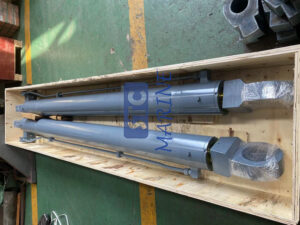
Main Classification of Hydraulic Cylinder Types
Hydraulic cylinders are essential components in industrial systems, converting hydraulic energy into linear mechanical motion. They can be classified based on their structure, function, and application, so engineers and buyers need to understand the differences.
- Classification by structure
Single-acting hydraulic cylinders: operate using hydraulic pressure in one direction only; return stroke is achieved by:
- Spring force
- Gravity
Applications:
- Lifting equipment
- Dump trucks
- Simple pressing systems
Advantages:
- Simple design
- Lower cost
Limitations:
Limited control over return movement
Double-acting hydraulic cylinders: Hydraulic pressure is applied in both directions, providing full control over extension and retraction. Applications include construction machinery, industrial automation, and manufacturing equipment.
Construction machinery
Industrial automation
Manufacturing equipment
Advantages:
- Precise motion control
- Higher efficiency
- Classification by Construction Design
Tierod cylinders
The cylinder barrel is secured with external tie rods.
Features:
- Easy maintenance
- Standardised design
Applications:
- Industrial machinery
- Factory automation
- Welded cylinders
The barrel is welded directly to the end caps.
Features:
- Compact structure
- Higher pressure capability
Applications:
- Mobile equipment (e.g., excavators and loaders)
- Telescopic cylinders: multistage cylinders with nested tubes
Features:
Long stroke with compact retracted length
- Applications:
- Dump trucks
- Material handling systems
- Classification by function
Cushioning cylinders: built-in cushioning mechanism at stroke ends.
Purpose:
- Reduce impact and vibration
- Locking cylinders, equipped with locking mechanisms to maintain position under load
- Rotary cylinders convert hydraulic energy into rotational motion
Applications:
- Indexing tables
- Industrial automation
- Classification by application
Mobile hydraulic cylinders: used in moving equipment. Examples:
- Construction machinery
- Agricultural equipment
- Industrial hydraulic cylinders
- Used in fixed industrial systems
Examples:
- Press machines
- Injection moulding machines
-
Classification by Pressure Rating
| Type | Pressure Range | Application |
| Lowpressure | < 7 MPa | Light-duty systems |
| Mediumpressure | 7–21 MPa | General industrial use |
| Highpressure | > 21 MPa | Heavy machinery |
Primary Types of Hydraulic Cylinders (Detailed Analysis)
-
SingleActing Hydraulic Cylinder
A single-acting hydraulic cylinder uses hydraulic pressure to move the piston in one direction only. The return stroke is then achieved by gravity, a spring, or an external force.
Key features:
- One fluid port
- Simpler design
- Lower cost
Applications:
- Hydraulic jacks
- Lifting platforms
- Dump trucks
Advantages:
- Cost-effective
- Easy maintenance
Limitations:
Limited control (one-directional force)
-
Double-Acting Hydraulic Cylinder
A double-acting hydraulic cylinder applies hydraulic pressure on both sides of the piston, enabling controlled movement in both directions.
Key features:
- Two fluid ports
- Simpler design
- Lower cost
Applications:
- Hydraulic jacks
- Lifting platforms
- Dump trucks
Advantages:
- Cost-effective
- Easy maintenance
Limitations:
Limited control (one-directional force) Double-acting hydraulic cylinder
A double-acting hydraulic cylinder applies hydraulic pressure on both sides of the piston, enabling controlled movement in both directions.
Key features:
- Two fluid ports
- Bidirectional force
- High control precision
Applications:
- Excavators
- Industrial machinery
- Marine steering systems
Advantages:
- Versatile
- High efficiency
Limitations:
More complex design
-
Telescopic Hydraulic Cylinder
A telescopic hydraulic cylinder consists of multiple nested stages that extend sequentially, allowing long strokes from a compact structure.
Key features:
- Multiple fluid ports
- High control precision
Applications:
- Excavators
- Industrial machinery
- Marine steering systems
Advantages:
- Versatile
- High efficiency
Limitations:
More complex design Telescopic Hydraulic Cylinder
A telescopic hydraulic cylinder consists of multiple nested stages that extend sequentially, allowing long strokes from a compact structure.
Key features:
- Multistage extension
- Compact storage length
- High stroke capability
Applications:
- Dump trucks
- Cranes
- Marine lifting systems
Advantages:
- Spacesaving design
- Extended reach
Limitations:
- Higher cost
- Complex maintenance
-
TieRod Hydraulic Cylinder
A tierod cylinder uses external threaded rods to hold the cylinder together.
Key features: modular construction, easy disassembly, standardised design.
Applications: industrial machinery, manufacturing systems.
Advantages: easy maintenance, cost-effective.
Limitations: lower strength compared to welded cylinders.
-
Welded Hydraulic Cylinder
A welded hydraulic cylinder features a fully welded body, providing a compact and robust design.
Key features:
- Strong construction
- Compact size
- High pressure resistance
Applications:
- Construction equipment
- Mobile machinery
- Marine systems
Advantages:
- High durability
- Space-efficient
Limitations:
Harder to repair
Manufacturers like STC Marine Engineering Limited often use welded designs for marine environments due to their strength and resistance to harsh conditions.
-
DoubleRod Hydraulic Cylinder
A doublerod cylinder has rods extending from both sides of the piston, allowing equal force and speed in both directions.
Key Features
- Symmetrical design
- Equal force output
- Balanced movement
Applications
- Precision machinery
- Automation systems
-
Tandem Hydraulic Cylinder
A tandem cylinder consists of two cylinders connected in series to increase force output without increasing the diameter.
Key features: increased force capacity, compact footprint.
Applications: heavy-duty industrial presses, high-load systems.

Comparative Analysis of Hydraulic Cylinder Types
Structural Comparison
| Type | Structure | Force Direction | Complexity | Typical Use |
| SingleActing | Simple | Oneway | Low | Lifting |
| DoubleActing | Dual chamber | Twoway | Medium | Machinery |
| Telescopic | Multistage | One/two-way | High | Long stroke |
| TieRod | Bolted rods | Twoway | Medium | Industrial |
| Welded | Welded body | Twoway | Medium | Heavyduty |
| DoubleRod | Symmetrical | Twoway | Medium | Precision |
| Tandem | Dual cylinder | Oneway | High | High force |
Performance Comparison
| Factor | SingleActing | DoubleActing | Telescopic | Welded |
| Cost | Low | Medium | High | Medium |
| Force Control | Low | High | Medium | High |
| Durability | Medium | High | Medium | Very High |
| Maintenance | Easy | Moderate | Complex | Moderate |
ApplicationBased Selection Guide
To select the right hydraulic cylinder, you need to align its technical specifications with your realworld application needs. Mismatching these can lead to inefficiency, premature failure, or increased operational costs.
- Define load requirements
The first step is to understand the force required for your application.
Key factors:
- Load weight
- Required force (kN or tons)
- Safety factor (typically 1.25–1.5x)
Insight:
Undersized cylinders lead to failure, while oversized ones increase cost and energy consumption.
- Determine stroke length
The stroke length must match the movement range of your system.
Consider:
- Maximum extension required
- Space limitations when retracted
- Need for multistage (telescopic) design
Tip:
Telescopic cylinders are ideal for long strokes in limited spaces.
- Evaluate operating pressure
Hydraulic systems operate under different pressure ranges.
Key points:
- Match the cylinder rating to the system pressure.
- A higher pressure allows for a smaller cylinder size.
- Ensure safety compliance.
- Choose mounting style
Mounting affects alignment, load distribution, and performance.
Common types:
- Flange mounting
- Clevis mounting
- Trunnion mounting
Insight: Incorrect mounting can cause uneven wear and reduce the lifespan of the system.
- Select cylinder type based on motion
Options:
- Single-acting: simple lifting tasks
- Doubleacting: controlled bidirectional movement
Telescopic: long stroke applications
- Consider environmental conditions
The operating environment has a significant impact on durability.
Factors:
- Temperature extremes
- Corrosive environments
- Dust and contamination
Tip:
Use special seals or coatings for harsh environments.
- Check speed and cycle requirements
Performance depends on flow rate and system design.
Consider:
- Required extension/retraction speed
- Frequency of operation (duty cycle)
Insight: High-cycle applications require more durable designs and better sealing systems.
- Maintenance and lifecycle costs
The total cost of ownership is more important than the initial price.
Evaluate:
- Ease of maintenance
- Availability of spare parts
- Service support
Industry Applications
Hydraulic cylinders are widely used across a range of industries thanks to their ability to deliver high force and precise control.
- Construction and heavy equipment
Applications:
- Excavators (boom, arm, and bucket control)
- Loaders and bulldozers
- Cranes and lifting systems
Key requirements:
High load capacity and durability
- Manufacturing & Industrial Automation
Applications: Manufacturing and industrial automation
Applications:
- Press machines
- Injection moulding machines
- Automated production lines
Key requirement:
Precision and repeatability
- Agricultural equipment
Applications:
- Tractors
- Harvesters
- Sprayers
Key requirement:
Reliability in harsh outdoor conditions
- Transportation and logistics
Applications:
- Dump trucks (lifting beds)
- Tail lifts and loading platforms
- Material handling systems
Key requirement:
Compact design and high lifting force
- Energy and mining
Applications:
- Drilling equipment
- Mining machinery
- Offshore platforms
Key requirement:
Extreme durability and resistance to harsh environments
- Marine and offshore
Applications:
- Steering systems
- Deck machinery
- Hatch covers
Key requirement:
Corrosion resistance and sealing performance
- Aerospace and defence
Applications:
- Aircraft landing gear systems
- Control actuators
Key requirement:
High precision and safety compliance
Emerging Trends in Hydraulic Cylinder Technology
Smart cylinders with sensors
Corrosion-resistant coatings
Lightweight composite materials
Energy-efficient hydraulic systems
FAQ: Hydraulic Cylinder Types
- What are the main types of hydraulic cylinders?
Singleacting, doubleacting, telescopic, welded, tierod, tandem, and doublerod cylinders.
- Which hydraulic cylinder is most commonly used?
Double-acting cylinders are the most widely used due to their versatility.
- What is the difference between single-acting and doubleacting cylinders?
Single-acting works in one direction, while double-acting provides force in both directions.
- Where are telescopic cylinders used?
They are used in applications requiring long strokes, such as dump trucks and cranes.
- Which cylinder is best for heavy-duty applications?
Welded and tandem cylinders are best for heavy-duty environments.
- How do I choose the right hydraulic cylinder?
Consider load, stroke, environment, and required control precision.
Conclusion
It is essential to understand the different types of hydraulic cylinders to make informed engineering and procurement decisions. Each type offers unique advantages tailored to specific operational needs:
- Singleacting: simplicity
- Doubleacting: versatility
- Telescopic: long strokes
- Welded: durability
- Tandem: high force
For B2B buyers, selecting the right hydraulic cylinder — especially from experienced manufacturers like STC Marine Engineering Limited — can significantly enhance system performance, reduce downtime, and improve long-term ROI.