
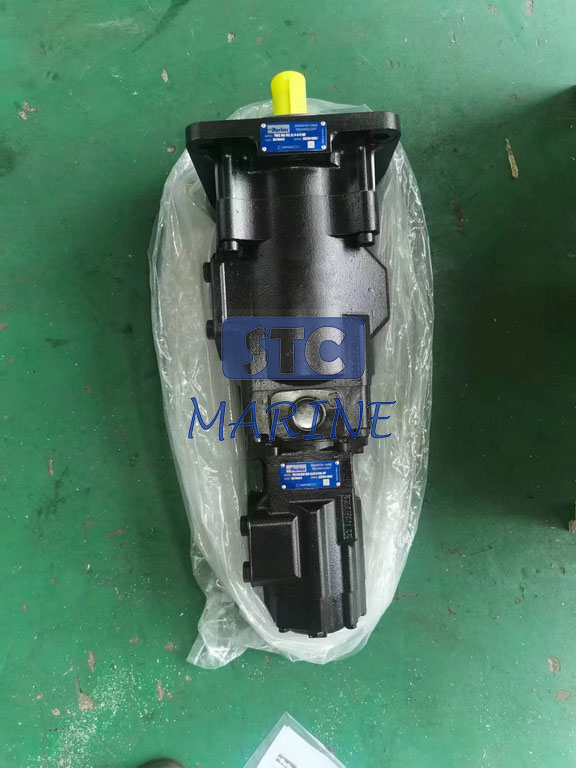


Article Abstract:
Hydraulic systems are based on a fundamental component that creates flow and allows for controlled power transmission: the hydraulic pump.
Hydraulic pumps are categorized into three large classes- gear pumps, vane pumps, and piston pumps- based on their mechanical design and principles of operation.
This article provides a comprehensive, industry-oriented description of the three primary types of hydraulic pumps. It explains the mechanism of each, where it is most effective, and why no single design is consistently superior.
By combining scientific research, industry standards, and practical application logic, this guide attempts to assist engineers, OEMs, and purchasing professionals in selecting the most effective hydraulic pump for efficiency, reliability, and lifespan.
Introduction: Why Understanding Hydraulic Pump Types Matters?
Today, hydraulic systems are commonplace in industry; they are used in conjunction with other machines that require power, such as the injection molding machine, the metal forming press, the agricultural equipment, the marine system, and the aerospace platform.
All of these devices require power. At the core of each of these systems is the hydraulic pump, the component that converts mechanical energy into hydraulic energy in the form of pressurized fluid flow.
Despite their commonality, hydraulic pumps are often misconstrued or overgeneralized. Many online resources describe pumps as being simple, but they focus on the definitions rather than the practical applications.
In practice, the choice of hydraulic pump type directly affects system efficiency, controllability, noise level, service life, and total cost of ownership. Selecting a bad pump can lead to energy loss, overheating, pressure control issues, or early failure.
The practice of industry and academic research consistently identifies three primary types of hydraulic pumps: the gear pump, the vane pump, and the piston pump.
These designs are fundamentally different in internal design, pressure capacity, efficiency of volume, and specialty applications. Understanding these discrepancies is crucial to the design of systems and the selection of hydraulic components.
What Is a Hydraulic Pump?
A hydraulic pump is a mechanical apparatus that converts mechanical energy, typically provided by an electric motor or internal combustion engine, into hydraulic energy. The energy is then transferred to a hydraulic circuit that is pressurized. Unlike compressors, hydraulic pumps do not reduce the pressure of the fluid themselves; instead, they produce flow, and the system’s resistance produces pressure.
From a mechanical perspective, pressure in a hydraulic system is not derived solely from the pump. Pressure is created when the flow generated by the pump encounters resistance, which is exemplified by valves, actuators, or load forces. This distinction is important in the evaluation of pump efficiency and overall behavior.
Hydraulic pumps are typically considered to be positive-displacement pumps. This is because they displace a fixed volume of fluid during every cycle or every rotation. This attribute grants precise control of the flow and a predictable performance. This is ideal for applications that require high force and low speed.
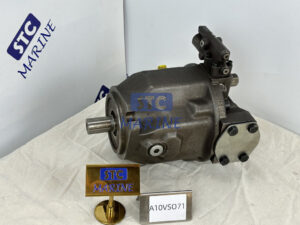
Classification of Hydraulic Pumps
Hydraulic pumps are categorized in multiple ways- by displacement type (fixed or variable), the operating pressure, or the control method. However, the most commonly embraced and practical classification is based on mechanical design, which produces three primary classes:
- Gear Pump
- Vane Pumps
- Piston Pump
Each of these designs has a distinct mechanical attribute that affects efficiency, pressure, noise, and maintenance.
Type 1: Gear Pumps
- The Base of the Structures and the Operating Method
Geared pumping is the simplest and most commonly employed type of hydraulic pump. They function by utilizing the meshing motion of the gears’ rotation to capture and convey fluid from the entrance to the exit. As the gears move, fluid is migrated toward the spaces between the teeth of the gear and the housing of the pump. There, it is then forced out under pressure when the gears intersect again at the exit.
Two primary varieties exist: external gear pumps, which have two identical gears that mesh together, and internal gear pumps, which have a smaller inner gear that rotates within a larger outer gear. Both concepts utilize small clearances to reduce internal flow loss and maintain the efficiency of volume.
- Performance Traits
Geared pumps’ efficiency, versatility, and cost are recognized. They typically have a pressure range of 200-250, though high-performance models may have a higher range. Because of the fixed displacement nature that is fixed, the flow rate is directly related to the rotational speed.
However, geared pumps’ noise and efficiency are typically higher than those of other more advanced pump types. Internal moisture increases with use, which leads to a decrease in performance over time.
- Common Examples
Gear pumps are commonly utilized in situations where the need for precise control is less important than reliability and ease. Common areas of focus include agricultural machinery, mobile hydraulics, lubrication, and basic industrial equipment.
Type 2: Vane Pumps
- Structural Design and Mechanism of Action
Vane pumps’ rotors are slotted and are mounted with a small eccentricity within a cam ring. Vanes migrate in and out of the rotor’s slots due to the force of centrifugality or the spring’s pressure; they maintain contact with the cam’s surface. As the rotor moves, the volume of fluid between the adjacent vanes increases at the entrance and decreases at the exit, which generates a flow of fluid.
The capacity of vanes to maintain communication with the housing facilitates a more consistent flow pattern than does gear pumping. This design inherently diminishes vibrations and noise.
- Performance and Efficiency
Vane pumps have a typical pressure capacity of up to 140-210 bars, which is dependent on the design and materials. They have a higher volume of efficiency and lower noise than mechanical pumps, which makes them ideal for use in industrial environments.
One of the primary benefits of vane pumps is their capacity to deal with variable displacement configurations, which allows for control of the flow without altering the rotation frequency. However, vane pumps are more susceptible to fluid imbuing and require a higher degree of cleanliness.
- Common Examples
Vane machines are common in machine tools, injection molding machines, die casting machines, and power plants that require consistent pressure and a low noise level.
Type 3: Piston Pumps
- Design variants and operating principles
Piston pumps are the most advanced and versatile type of hydraulic pump. They employ reciprocating pistons that are arranged either axially or radially to propel fluid. The two most common varieties of pumps are axial and radial.
In devices with axial motion, pistons are positioned perpendicular to the motion axis and are connected to a swash plate or mechanism with a bend. Changing the angle of the swash plate alters the length of the piston’s stroke, which enables variable displacement control.
- Performance Abilities
Piston pumps have the highest pressure ratings of any pump; these are often over 350 bar and can reach 700 bar in specialized applications. They also provide a superior degree of volumetric and overall efficiency, which is especially true of variable configurations of displacement.
Their capacity to adapt to changing flows makes it ideal for use in energy-efficient systems, because the flow is only provided as needed instead of being continuously replenished.
- Business Relationships
Piston pumps are the most popular of high-performance appliances, like hydraulic presses, aerospace actuation, heavy equipment used in construction, offshore platforms, and precision hydraulic systems.
Comparison of the Three Main Hydraulic Pump Types
| Pump Type | Typical Pressure Range | Efficiency | Noise Level | Cost | Common Applications |
| Gear Pump | Up to ~250 bar | Moderate | High | Low | Mobile hydraulics, agriculture |
| Vane Pump | Up to ~210 bar | Good | Low | Medium | Machine tools, industrial units |
| Piston Pump | 350–700 bar | Very High | Medium | High | High-performance industrial systems |
Fixed vs Variable Displacement Across Pump Types
While gear pumps’ sole displacement is fixed, both vane and piston designs are available in versions that are fixed or variable.
Constant displacement pumps have a significant role in reducing the amount of energy required for hydraulic systems that are energy efficient by reducing losses of throttling and minimizing the amount of heat generated.
Piston pumps, in particular, have a strong presence in modern load-sensing and pressure-compensated systems. These systems are characterized by efficiency and precise control.
How to Choose the Right Hydraulic Pump?
Selecting the appropriate hydraulic pump is complex and involves balancing multiple factors: the operating pressure, the flow needed, the duty cycle, the environmental conditions, the noise that is desired, and the budget that is available. No single pump type is consistently superior; instead, the most effective choice is based on the system’s priorities.
In applications that are sensitive to cost but have a moderate pressure requirement, gear pumps still serve as a practical option. For ruído-suppressing environments that are low in noise, vane pumps have a proportional balance.
When productivity, control, and high pressure are of paramount importance, piston pumps are the most common type.
Common Misconceptions About Hydraulic Pumps
A common misconception is that increased pressure capacity is always associated with improved performance. In practice, overpecifying the pressure required for the pump leads to increased costs and complexity without providing any functional benefits.
Another misconception is that pumps are thought to create pressure in an independent manner, instead of recognizing pressure as a system-wide phenomenon.
Future Trends in Hydraulic Pump Technology
Recent advances have focused on electro-hydraulic integration, digital displacement generators, and enhanced surface coatings that have the potential to increase efficiency and extend life.
Other concerns with sustainability have also led to designs that are optimized for use in biodegradable fluids and that have a lower energy consumption.
Frequently Asked Questions (FAQ)
What are the three primary types of water pumped by hydraulics?
The three primary types of hydraulic pumps are geared, vaneed, and pistoned, all of which are classified by their mechanical design and operating principles.
Which pump for water is most effective?
Piston pumps have the highest efficiency, particularly in configurations that vary the displacement of the fluid. These systems are used in load-sensing applications.
Is the concept of gearing still important in modern hydraulics?
Yes. Gear pumps are still popular because of their simple design, long life, and low cost, particularly in portable and agricultural applications.
Which pump is most effective for high-pressure systems?
Piston pumps are most effective for high pressure and high performance; they are often used for systems that operate at over 350 bars.
How does the selection of a pump affect the lifespan of the system?
The correct choice of pump reduces heat generation, improves lubrication, and reduces wear, all of which significantly affect the system’s lifespan.
Conclusion
Understanding the three primary types of hydraulic pumps—gear, vane, and piston—is crucial to creating effective, dependable, and cost-savings hydraulic systems. Each pump type has a distinct composition of capabilities, difficulty, and practicality.
By choosing the pumping mechanism in conjunction with the system’s requirements rather than withits assumptions, engineers and decision makers can lead to superior operational results and a long term value.