

Article Summary:
Hydraulic Cylinders for Free Fall Lifeboat Davits play a critical role in modern marine safety systems, enabling controlled positioning, locking, and reset operations of free-fall lifeboats under extreme conditions.
According to the International Convention for the Safety of Life at Sea (SOLAS) and technical guidance published by the International Maritime Organization (IMO), free-fall lifeboat systems must ensure reliable, fail-safe operation even during power loss or emergency deployment scenarios. Industry literature, such as Marine Hydraulic Systems (Elsevier) and ISO standards for offshore lifting equipment, further emphasizes the importance of robust hydraulic cylinder design, corrosion resistance, and redundancy in davit mechanisms.
This article provides an in-depth, industry-oriented explanation of how hydraulic cylinders function within free-fall lifeboat davits, their design principles, regulatory context, operational characteristics, and selection considerations for shipowners, yards, and OEM suppliers.
Introduction: Why Hydraulic Cylinders Matter in Free Fall Lifeboat Davit Systems
Free-fall lifeboats are among the most important appliances for life-saving that are installed on modern vessels, platforms, and special ships. Unlike conventional buoyed lifeboats that rely on gravity to launch them, free-fall systems are controlled by a release mechanism that is released safely. This mechanism allows the lifeboat to slide or drop into the ocean at a planned trajectory and speed. Within this framework, hydraulic cylinders have a significant, but often-overlooked, role.
Hydraulic Cylinders that are free-fall are not simply movers. They’re safety components that are precision-engineered to operate efficiently in high static pressure, rapid dynamic motion, marine environments that are corrosive, and stringent international regulations. Their success or failure directly affects the safety of the crew, the complianc of regulations, and the certification of vessels.
As the safety standards for maritime transportation have continued to increase and vessels have operated in more demanding conditions, understanding the way these cylinders function and why they are important is now essential to the marine engineering community, shipyards, classification societies, and purchasing professionals.
Understanding Free Fall Lifeboat Davits
To understand the functionality of hydraulic cylinders, it’s first necessary to understand the basic makeup of a free-fall lifeboat davit.
A free-fall lifeboat that is davit is typically composed of a launching ramp or skid, a holding mechanism that releases the lifeboat, structural supports, and a hydraulic or mechanical system that controls the position and re-positioning of the lifeboat. During typical operation, the lifeboat is maintained at a slant angle that is inclined by a set of latches. In emergencies, the release system is triggered, which allows the lifeboat to travel at a fast rate and enter the water outside of the vessel.
Hydraulic cylinders are part of this system and allow for controlled movement that is not possible with safety methods alone.
What Are Hydraulic Cylinders for Free Fall Lifeboat Davits?
Hydraulic Cylinders for Free Fall Lifeboats are mechanical devices that convert pressure from the hydraulic system into a controllable force. Within davit systems, these cylinders are primarily employed to:
Maintain and change the angle of launch of the lifeboat.
Control the locking and unlocking process.
Help with resetting and recovering from drilling or monitoring.
Provide motion or damping during placement.
Unlike standard-commercial cylinders that are general purpose, marine davit cylinders are engineered to have a high degree of reliability, long lifespans, and compliance with maritime safety regulations.

Key Functions of Hydraulic Cylinders in Free Fall Davit Systems
- Angle and Positioning Control
Before it’s deployed, the lifeboat must be precisely angled to ensure a safe course of travel and water consumption. Hydraulic cylinders provide the necessary force and precision to adjust and maintain this angle, which is compensated for by the trim or load of the vessel.
- Operating with a Key
In many configurations, hydraulic cylinders serve as the actuator for locking arms or pons that keep the lifeboat in its prepared position. These cylinders must have a significant static pressure that can be maintained for a long period of time without the loss of pressure or creep.
- Rebuild and Recover After Disaster Drills
After conducting a test launch or drilling, the lifeboat must be repositioned in its original place. Hydraulic cylinders facilitate controlled lifting or repositioning, which diminishes the effort required of manual labor and minimizes the stress placed on the davit.
- Safe-Behavior Failure
A fundamental requirement of SOLAS is that the failure of the hydraulic system should not impede the emergency response. As a result, davit cylinders are typically built to withstand a loss of hydraulic pressure; instead of locking the system, this allows for a safer release.
Design Characteristics of Marine Hydraulic Cylinders
Hydraulic Cylinders for Free Fall Lifeboats differ from standard cylinders in both design and material.
- High-Capacity Load
These cylinders must be able to support the combined weight of the lifeboat, crew, and the dynamic forces associated with vessel movement. Safety factors are typically more significant than in non-safety-critical apps.
- Corrosion Resistance
Marine habitats have to deal with saltwater, humidity, and temperature changes. Cylinders are typically produced using the following methods:
Stainless steel or high-quality carbon steel that has a marine coating.
Piston rods coated with Chrome or ceramic.
Seals that are intended for use in saltwater.
- Low Maintenance Design
Because of their limited access and safety concerns, cylinders are intended for long service lives, which often exceed five years with proper care.
Hydraulic System Integration
Hydraulic cylinders do not function alone. They are part of a larger hydraulic system that includes hydriders, accumulators, control valves, and piping.
Handling of the manual and emergency operations
The LSA and the SOLAS Code necessitate that lifeboats equipped with free-fall systems remain functional in the event of a power failure. Hydraulic systems are often equipped with manual paddle arms or energy storage devices that are intended to ensure the actuation of cylinders in emergent conditions.
Redundancy and Safety Logic
In critical davit systems, extra redundancy is typically incorporated into the control valves or hydraulic circuits of the system to prevent a single point of failure from stopping the entire system.
Regulatory Framework Governing Hydraulic Cylinders for Davits
- Solas Goals
SOLAS defines the general requirements for safety and performance in life-saving appliances. Despite not having a specific prescription for the exact dimensions of cylinders, it nevertheless mandates that they be dependable, strong, and have a fail-safe behavior.
- IMO LSA Number
The Life-Saving Appliances Code contains more specific instructions regarding the testing, operation, and inspection of free-fall lifeboats; these indirect effects on the design of hydraulic cylinders are discussed in greater detail in the Code.
- The classification society rules
Organizations like DNV, ABS, and Lloyd’s Register add extra requirements to the certification process, testing, and documentation of hydraulic cylinders associated with davit systems.
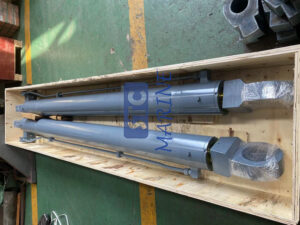
Types of Hydraulic Cylinders Used in Free-Fall Lifeboat Davits
| Cylinder Type | Typical Function | Key Advantage | Common Application |
| Single-Acting Cylinder | Holding and release assistance | Simple, fail-safe | Locking mechanisms |
| Double-Acting Cylinder | Controlled positioning | Precise motion control | Angle adjustment |
| Telescopic Cylinder | Compact high stroke | Space efficiency | Recovery systems |
| Dampened Cylinder | Shock reduction | Reduced structural stress | Reset operations |
This variety allows system designers to tailor cylinder selection to specific operational and safety requirements.
Failure Modes and Risk Mitigation
Because of their critical role in safety, understanding the potential failure modes is crucial.
- Seal Deterioration
Being around salt and ultraviolet radiation can adversely affect seals over time. Elastomers that are marine-grade and scheduled audits reduce the likelihood of this occurring.
- Internal Flush
The loss of pressure holding can lead to the compromise of locking functionality. High-precision cutting and quality assessment diminishes this probability.
- Corrosion- induced wear
Preventative coatings and frequent monitoring are crucial to avoiding corrosion-related malfunctions.
Maintenance and Inspection Practices
Cylinders used in the Free Fall method are subjected to stringent rules.
Visual assessments during standard safety audits
Functional testing during the drilling of boathouses.
Periodic pressure testing during the dry dock.
Effective documentation of maintenance activities is often important for students’ success.
Selection Criteria for Hydraulic Cylinders
When designing or purchasing hydraulic cylinders for use in free-fall stands, professionals in the industry typically consider:
Violation of the SOLAS and adherence to the class rules
The capacity to load and the safety factor.
Protection level against corrosion
compatibility with existing water systems
Access to spare parts and after-sales services is available.
These guidelines help ensure long-term operational stability and regulatory approval.
Market Trends and Technological Developments
- Advances in Coating Technology
Increasing the surface treatment’s sophistication is extendiendo the life of the cylinders in harsh marine habitats.
- Condition Monitoring
Some modern systems have sensors that measure the position of the cylinders and the pressure inside, which supports the implementation of strategies that are preemptive in nature.
- A commonality between Fleets
Fleet operators are increasingly interested in standardized design cylinders that would facilitate both maintenance and the logistics of spare parts.
Industry Applications Beyond Merchant Shipping
While primarily associated with cargo vessels and tankers, Hydraulic Cylinders are also employed in:
- Offshore oil and gas facilities
- Coastal and naval vessels
- specialized research vessels
Each use of the application requires a unique set of operational requirements that has an effect on the design of the cylinders.
FAQ: Hydraulic Cylinders for Free Fall Lifeboat Davits
Q1: What is the primary function of hydraulic cylinders in free-fall lifeboat davits?
They facilitate controlled placement, locking, and resetting that is essential for safe operation and compliance with the maritime safety regulations.
Q2: Are hydraulic cylinders necessary in floundering lifeboats?
While not explicitly required, hydraulic cylinders are commonly employed to efficiently achieve functional and safety goals.
Q3: How long do marine water reservoirs typically last?
With proper care, the service life is often longer than 10 years, depending on the conditions in which it is operated.
Q4: Can a lifeboat that is free-fallable be employed if the hydraulic system is unable to function?
Yes. Systems are intended to ensure emergency release in the event of no power.
Q5: What regulations regulate these hydraulic cylinders?
They are affected by the SOLAS code, the IMO LSA Code, and the rules of society regarding classification.
Conclusion
Theraulic Cylinder for Free Fall Lifeboats is crucial to the modern safety system of marine vessels. Their function is much more extensive than simply acting; they also have the capacity to hold loads, move them, and exhibit safe behavior that will occur under the most adverse conditions.
For boatowners, designers, and other individuals involved with marine transportation, a comprehensive understanding of how these cylinders function and how they fit into safety regulations is crucial to ensuring the safety of the crew, compliance with regulations, and long-term operational dependability. As the field of maritime technology continues to progress, hydraulic cylinders will still be a significant part of the design of effective free-fall lifeboats.